Reading in the dark
On private capital, which now finances most of what gets built and publishes almost nothing, and on the curious, almost literary skill that such darkness rewards.
Norvian Review9 October 202623 minutes
The outstanding fact is the extreme precariousness of the basis of knowledge on which our estimates of prospective yield have to be made.
Try to be one of the people on whom nothing is lost!

IThe candle
In the Los Angeles County Museum of Art hangs a painting by Georges de La Tour of a young woman sitting at a table in the night. A wick burns in a glass of oil in front of her, and its smoke rises in a thin, straight line. One hand rests on a skull in her lap, the other supports her chin, and she looks into the flame rather than at anything the flame lights. The table holds two books and a wooden cross. Everything else in the room has gone. It is not that the corners are dim; they have simply ceased to exist, because nothing in the picture is visible except what the one flame reaches. La Tour painted the scene more than once, and the effect is always the same. The darkness is not a background. It is the subject, and the little circle of light is an argument about how much of the world any one person can see at a time.
The painting comes to mind often in the reading of private companies' filings, because it is the most exact picture there is of what it is like to be asked for money by one. The public markets are, by comparison, a room with the lights on. A share in a listed company has a price at every second of the trading day, and behind that price stand a prospectus, years of audited accounts, quarterly results, analysts paid to disagree with one another and a regulator who fines people for saying one thing in private and another in public. Friedrich Hayek, writing in 1945, called the price system a machine for communicating knowledge that no single mind could hold, and marvelled at “how little the individual participants need to know in order to be able to take the right action”.1 The price does the knowing for them. Most of what is known about a listed company has already been folded into it, and the investor who buys at that price buys, along with the share, a summary of everyone else's homework.
A share in a private company has no price until two people agree one, and the agreement is private too. In the United States the only public trace of most private financings is a notice of a few hundred words, which says how much the company set out to raise and how much it has raised so far.2 In Britain there is not even that. There is a register of charges, which tells you that a company has borrowed, from whom and against what, and never how much.3 Hayek's machine has been switched off, and the investor is left with a candle.
This would be a curiosity if private markets were small, but they are not. Operating companies in the United States have filed notices for 207,688 private offerings since 2014.4 The business development companies, which are the only private lenders obliged to publish their books, hold $371.7bn of loans to 7,316 businesses, and they are perhaps a fifth of the private credit market at most.5 In Texas alone, the power plants that have a contract to connect to the grid and have not yet begun to build need, on our rough estimate, well over $100bn before they can turn a turbine.6 Most of what is now financed, built and employed is financed in the dark. That has consequences for how money is raised, and the most important of them is this: in a market without prices, capital is raised by argument, and the argument is tested by the light of a single candle, moved slowly around the room.
IILemons and lamps
The economist George Akerlof described in 1970 what ought to happen to a market of this kind.7 He took the example of used cars. The seller of a car knows whether it is a good one or a lemon; the buyer does not. Unable to tell them apart, the buyer will pay only the price of an average car. At that price the owners of good cars, who know their cars are worth more, decline to sell. The average quality of the cars on offer falls, the price the buyer will pay falls with it, and the next tier of good cars withdraws. In the limit the market unravels altogether, leaving nothing on the forecourt but lemons and nobody willing to buy them.
Private capital is the market Akerlof described, in the purest form it exists. The company knows things about itself that no investor can know: whether the largest customer is happy, whether the founder is tired, whether the margin in last year's accounts was a trend or an accident. By Akerlof's logic investors ought to assume the worst and pay accordingly, the best companies ought to refuse the price and go elsewhere, and private markets ought to be what their critics sometimes say they are: a place where the companies nobody else will fund go to be funded expensively. That they are not, that the best private companies in the world choose private capital and are pursued for the privilege of providing it, is owed to the investors' refusal to accept the darkness. They buy lamps.
Every question in a due diligence process is a lamp held up to one corner of the room. Who are the customers, and why do they stay? What happens to the margin if the largest one leaves? What does the debt cost, when does it fall due, and who decides whether it is refinanced? What did the last investor know that we do not? Michael Spence, who shared Akerlof's Nobel prize, added the other half of the answer: a company can also hold up its own lamps, provided they are expensive enough to be believed.8 An audit, a lender who has already committed, a founder who has put in their own savings, a customer who has signed for ten years: these are signals precisely because they are costly to fake. Frank Knight had drawn the distinction in 1921 between risk, which can be measured, and uncertainty, which cannot.9 The work of private investment is the slow conversion of the second into the first, one corner at a time, until enough of the room is lit that a price can be named.
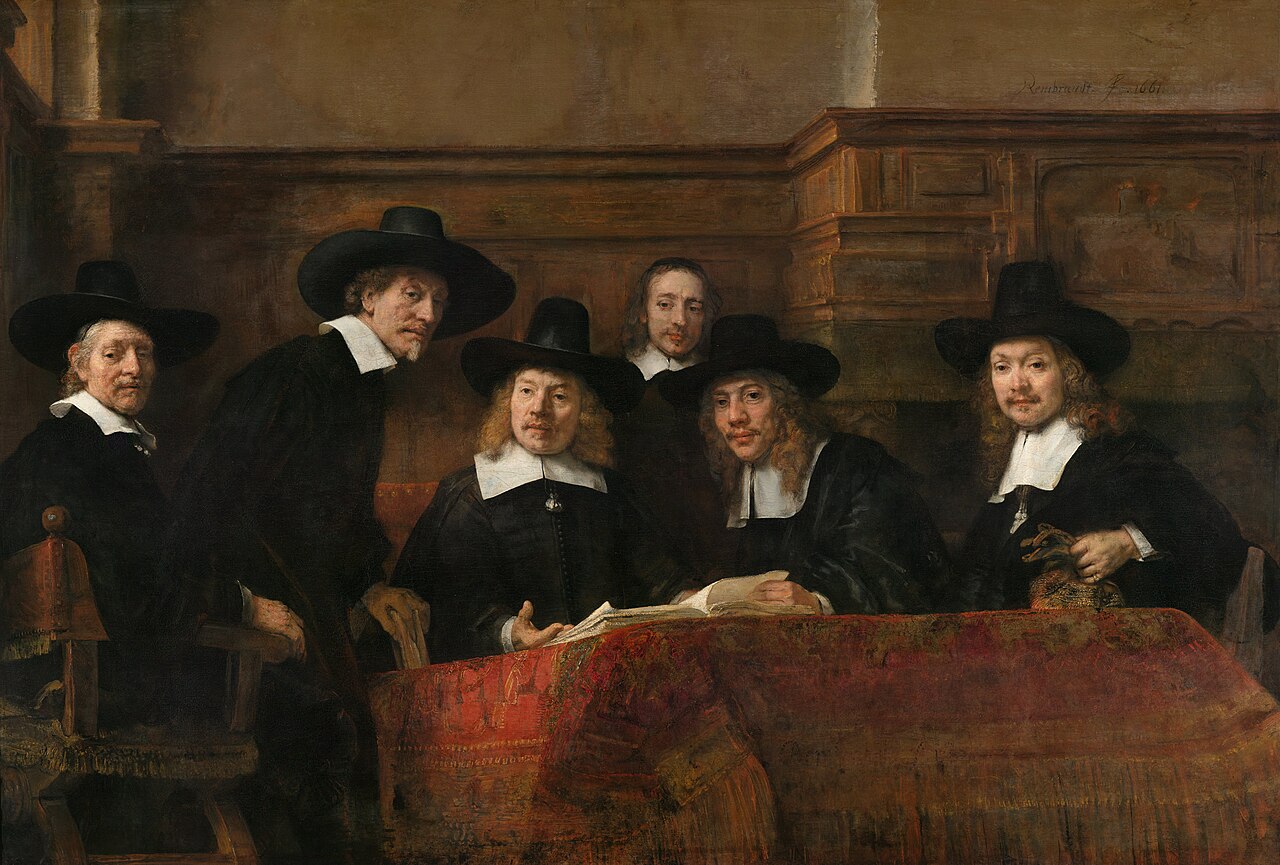
There is a painting of this work, too. In 1662 Rembrandt painted the board of the sampling officials of the Amsterdam drapers' guild, the men who tested dyed cloth against a book of samples and sealed the bolts that passed.10 They sit around a table covered with a Persian carpet, one of them half risen from his chair, and they look up from their book at us with an expression that every founder who has sat across from an investment committee will recognise. It is not hostility. It is attention, slightly interrupted, of people who have seen a great deal of cloth and are waiting to see whether ours will match the sample.
The cost of the lamps is time, and the cost has been rising. In 2021, when money was cheap and plentiful, the median private raise in the United States had ten investors. In 2024 and 2025 it had six, each writing a larger cheque.11 An investor who provides a larger share of a round has more to lose from what they cannot see, and spends longer looking. The share of raises that sell the full amount they set out to raise has fallen every year since, from 41.9% of those begun in 2021 to 30.7% of those begun in 2024.12 It is tempting to read that as a shortage of money, but most of it is something else: the same quantity of money moving more slowly, because each investor insists on lighting more of the room before they will name a price, and a good many companies run out of time before the room is lit.
IIIThe king died
What persuades an investor in the end, when enough of the room has been lit, is not the light itself but what the light reveals as a whole. The word for that whole is story. It is an unfashionable word among people who handle money, because it sounds like fiction, and the suspicion is understandable. But E. M. Forster drew the distinction that matters here in 1927, in a set of lectures on the novel. “The king died and then the queen died” is a story, he said. “The king died, and then the queen died of grief” is a plot.13 The first is a sequence of facts; the second is a cause. A data room, however complete, is the first kind of thing. It is a chronicle of the company: its accounts, contracts, policies, minutes and forecasts, each true and none of them connected. What an investor needs, and what almost no data room provides, is the second kind: an account of why these facts belong together, why the money is needed now, why this amount and this structure, and what follows when it arrives.
Joan Didion wrote that “we tell ourselves stories in order to live”, and then spent the rest of the essay that begins with that sentence doubting the stories she had told herself.14 The doubt is the investor's too. A story is a convenience, and sometimes a lie, and every experienced investor has been told a beautiful one by a company that did not survive the year. So the story is tested rather than admired. But it is the story that tells the investor which facts to test. A data room answers questions; a plot tells the reader which questions matter. Without it the investor must test everything, which is impossible, or test at random, which is worse.
The best test of a story is whether it can be retold, and here Walter Benjamin is a better guide than any textbook of corporate finance. In an essay of 1936 on the decline of the storyteller, Benjamin set the oral tale against the newspaper report. “The value of information does not survive the moment in which it was new,” he wrote. A story, by contrast, “does not expend itself. It preserves and concentrates its strength and is capable of releasing it even after a long time.”15 It survives because it is told from mouth to mouth, by people who did not invent it, to people who will tell it again.
That is the exact condition of a private financing. The person a company pitches is rarely the person who decides. An associate pitches a partner, the partner pitches an investment committee, and the fund manager, in due course, explains the investment to the pension trustees whose money it is.16 At each step the story is retold by someone who did not write it, to someone who has never met the company, with less time than the telling before. A story that depends on the founder's presence, on a slide that needs explaining or on a figure that needs a footnote loses something at every step, and by the time it reaches the person who signs it is either clear or dead. Keynes, in the most quoted passage of The General Theory, compared professional investment to a newspaper beauty contest in which the prize goes not to the reader who picks the prettiest face but to the one who picks the face everyone else will pick. “We have reached the third degree where we devote our intelligences to anticipating what average opinion expects the average opinion to be.”17 The associate is playing that game too. The question in their mind is not whether they like the company but whether they can make the committee like it, and whether the committee can make the trustees like it in turn.
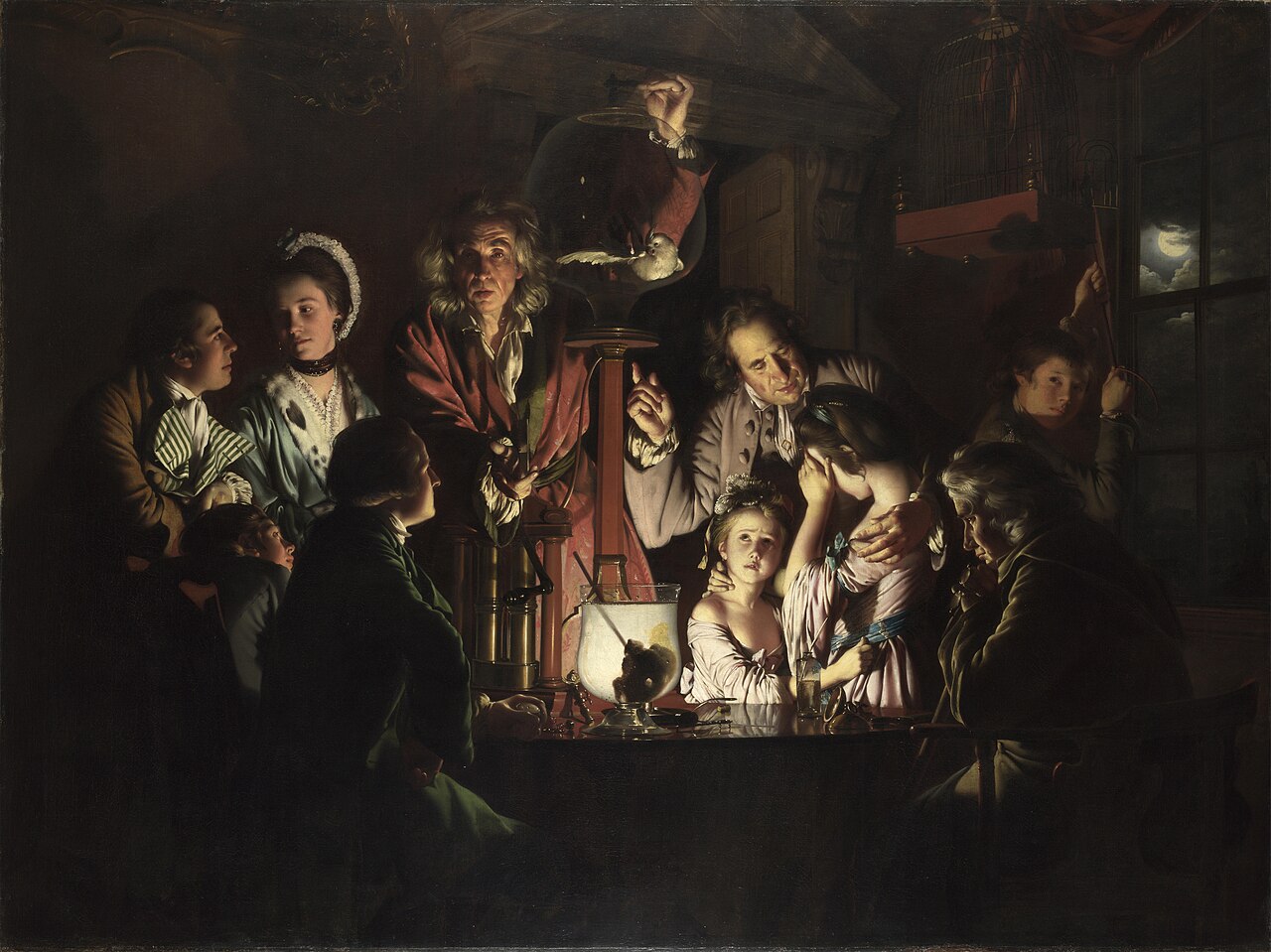
So a good raise is written for the second reader rather than the first. Joseph Wright of Derby painted, in 1768, a travelling lecturer demonstrating the vacuum to a family by candlelight.18 Every face in the picture reads the same event differently. A girl hides her eyes, her father explains, a man times the bird with his watch, and a pair of lovers have noticed nothing at all. The lecturer looks out of the canvas at us, his hand on the valve. A pitch is that demonstration, performed to a room that will scatter afterwards and describe it to people who were not there, and the founder's real audience is those people. It follows that the sentence which matters most in a financing is the one the associate will say to the committee. It should be short enough to be remembered, specific enough to be checked, and simple enough to be repeated by someone who is not an expert in the business. “A dental group buying practices from dentists who want to retire, run by a team that has done it before.” “A battery with a ten-year contract from a Japanese trading house.” “A sprinkler contractor in a market that the building regulations make larger every year.” Each of those sentences describes a company whose financing we have taken apart, and each carries most of the weight of its raise. They are plots in Forster's sense: they contain a cause.
IVThe skull on the floor
If a story is how a raise is won, a detail is how it is lost.
In the National Gallery in London hangs Holbein's portrait of two French envoys at the court of Henry VIII, painted in 1533.19 The men stand on either side of a shelf crowded with the instruments of their age's confidence: globes of the earth and the heavens, a sundial, a quadrant, an arithmetic book, a hymnal, a lute. Across the floor between them runs a long grey smear that looks, from the front, like a flaw in the paint. Walk to one side of the picture and look back along its surface, and the smear resolves into a human skull. It cannot be seen from where the picture asks to be seen; it can be seen only from the side, by someone who has moved. A string of the lute, if you look closely, is broken.
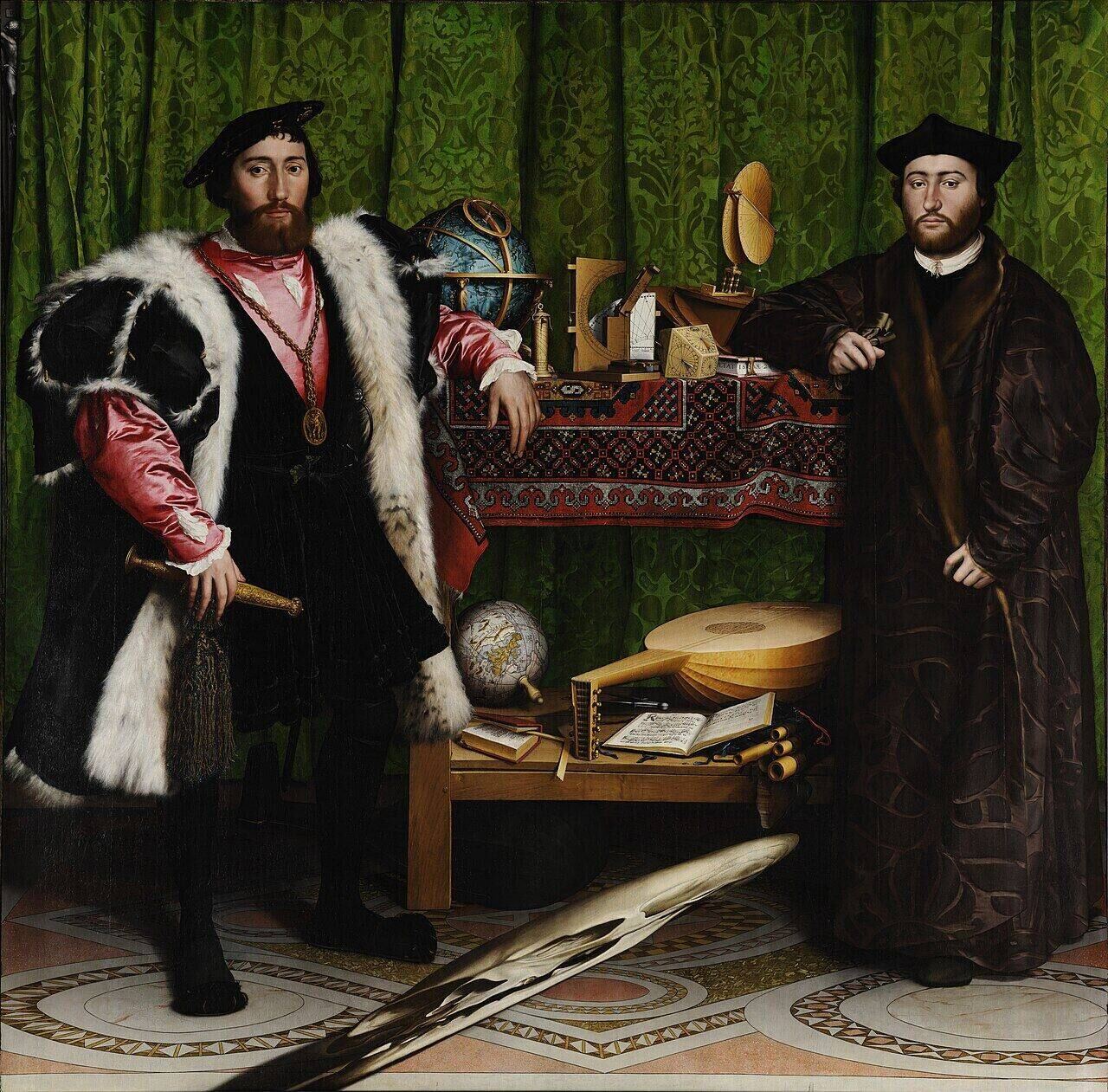
Due diligence is the art of walking to the side of the picture. An investor in the dark cannot test the whole of a company. They cannot know whether the market will grow as the company says, whether the team is as good as it seems, or whether next year will resemble the last. What they can test is the small things, and they test them because the small things can be seen from an angle the company did not choose. Is this number the same on page four as on page twenty? Does the list of customers add up to the revenue? Is the debt described in the deck the debt in the accounts? Does the founder know the gross margin without looking it up?
Shylock understood this better than any character in literature. When Bassanio asks him to lend three thousand ducats on Antonio's bond, Shylock replies that “Antonio is a good man”, and then, seeing Bassanio bristle, explains himself: his meaning “in saying he is a good man is to have you understand me that he is sufficient”. Good, for a lender, means good for the money. Then he does what a credit analyst does. He has heard on the Rialto that Antonio “hath an argosy bound to Tripolis, another to the Indies”, a third at Mexico and a fourth for England. Then he reflects that “ships are but boards, sailors but men: there be land-rats and water-rats, water-thieves and land-thieves, I mean pirates; and then there is the peril of waters, winds and rocks.”20 Every risk he names is a detail that a man in love with his own story would not think to mention. That Shylock is the villain of the play has never made his analysis wrong.
Small things stand for large ones, and investors use them that way deliberately. A company that gets the small things right has probably got the large ones right too, or at least knows where it is uncertain. A company that gets a small thing wrong has told the investor something about how it handles every fact the investor cannot check. One figure that does not reconcile can cost a raise that a hundred figures that do reconcile could not win. It is not the error that does the damage. It is what the error implies about the rest of the room.
The public record shows how easily such details drift, without anyone intending them to. A battery project in the West Midlands closed £45.55m of committed debt in May 2025, and some of the trade press reported it as £145m, because a £100m accordion that nobody had yet committed to was folded into the headline. A fire engineering group announced a refinancing “of up to £70 million”; its audited accounts record a facility of £35m. A dental group's adjusted earnings for a single year rose by more than a third between its original accounts and its amended ones, on the same operating loss.21 Nothing in any of this is improper. Each is the gap between how a fact was presented and what the documents say, and every one of them is a skull on the floor, invisible from the front and plain from the side. An investor who reads the documents will see it. The question is whether the company saw it first.
At any given time there exists an inventory of undiscovered embezzlement in, or more precisely not in, the country's businesses and banks. This inventory, it should perhaps be called the bezzle, amounts at any moment to many millions of dollars.
The passage is from John Kenneth Galbraith's history of the crash of 1929, lightly repunctuated here.22 Galbraith's point was that the bezzle swells in good times, when people are trusting and money is easy, and shrinks in bad, when everyone checks everything. He was writing about fraud, which is not what most details are. But the mechanism he described governs the honest error just as much. The diligence of private investors moves with the cycle. In 2021 a figure that did not reconcile was a question; in 2025 it is a reason. The founder raising money now is raising it from investors who have been walking to the side of the picture for three years, and who have found enough skulls to keep looking.
VThe map of the empire
The obvious response to a dark room is to light all of it, and companies often try. Jorge Luis Borges wrote a story of a single paragraph about an empire whose cartographers grew so exacting that a map of a province filled a city, and then made a map of the empire “whose size was that of the Empire, and which coincided point for point with it”.23 The following generations found it useless and abandoned it to the weather, and in the western deserts, Borges reports, “there are Tattered Ruins of that Map, inhabited by Animals and Beggars”.
A data room of four hundred documents is the map of the empire.24 It coincides with the company point for point, and it tells the reader nothing, because it has declined to choose. The investor who opens it must do the choosing, and an investor forced to choose will choose the corners where problems usually hide, which is to say the corners least flattering to the company. Completeness is not candour. It is the abdication of the one task that only the company can perform, which is to say which facts matter and why.
What the dark rewards, then, is something closer to a literary skill than a financial one. Henry James told young novelists to “try to be one of the people on whom nothing is lost”, and the instruction is usually read as advice to observe. It is equally advice to select, for the novelist who notices everything and selects nothing writes a telephone directory. The founder raising money is in the novelist's position. They know the company far better than any reader can, and their task is to choose the dozen details that, set in the right order, let a stranger see the whole. Each detail must be true from every angle, because each will be viewed from the side. Each must belong to the plot, because a detail that belongs to no plot is the first thing the second reader forgets and the first thing the investment committee asks about. And the plot must survive four retellings by people who will never meet the author.
There is a crack in everything, Leonard Cohen sang, and that is how the light gets in.25 The private markets are dark, but they are not sealed. A notice filed with the SEC says how much a company meant to raise and how much it raised. A lender's schedule of investments says what it charges, when the loan falls due and what the loan is worth today. A register of charges says who has lent against what. A queue of power projects says who has a grid connection and no money to build. None of these records was designed to illuminate anything, and each lights one corner of a very large room. Read together, and read carefully, they let an outsider see a surprising amount of what the insiders see, and that is the method of this publication.26
It is also the founder's best method. In a market with no prices, the only thing an investor can check is whether you are right about the small things. The founders who raise well are those who have walked around their own picture before anyone else is shown it, found the skull on the floor and the broken string on the lute, and either mended them or named them. They give the investor fewer documents and better ones. They write the sentence the associate will say to the committee, and they make sure that every figure in it can be seen from the side. They do not ask the investor to admire the candle. They tell the investor which corners of the room to look at, and why, and then they hand over the light.
Works cited
- Akerlof, George A. “The Market for ‘Lemons’: Quality Uncertainty and the Market Mechanism.” Quarterly Journal of Economics 84, no. 3 (1970): 488 to 500.
- Benjamin, Walter. “The Storyteller.” 1936. In Illuminations, edited by Hannah Arendt, translated by Harry Zohn. New York: Schocken, 1968.
- Borges, Jorge Luis. “On Exactitude in Science.” 1946. In Collected Fictions, translated by Andrew Hurley. New York: Viking, 1998.
- Cohen, Leonard. “Anthem.” On The Future. Columbia Records, 1992.
- Companies House. Find and update company information.
- Didion, Joan. The White Album. New York: Simon and Schuster, 1979.
- Electric Reliability Council of Texas. Generator Interconnection Status report, October 2026.
- Forster, E. M. Aspects of the Novel. London: Edward Arnold, 1927.
- Galbraith, John Kenneth. The Great Crash, 1929. Boston: Houghton Mifflin, 1955.
- Hayek, F. A. “The Use of Knowledge in Society.” American Economic Review 35, no. 4 (1945): 519 to 530.
- James, Henry. “The Art of Fiction.” Longman's Magazine, September 1884.
- Keynes, John Maynard. The General Theory of Employment, Interest and Money. London: Macmillan, 1936.
- Knight, Frank H. Risk, Uncertainty and Profit. Boston: Houghton Mifflin, 1921.
- Shakespeare, William. The Merchant of Venice. About 1597.
- Spence, Michael. “Job Market Signaling.” Quarterly Journal of Economics 87, no. 3 (1973): 355 to 374.
- US Securities and Exchange Commission. Form D data sets, 2014 to 2026; Business Development Company data sets, quarter to 30 June 2026.
Cite as: “Reading in the dark”, Norvian Review, 9 October 2026.